
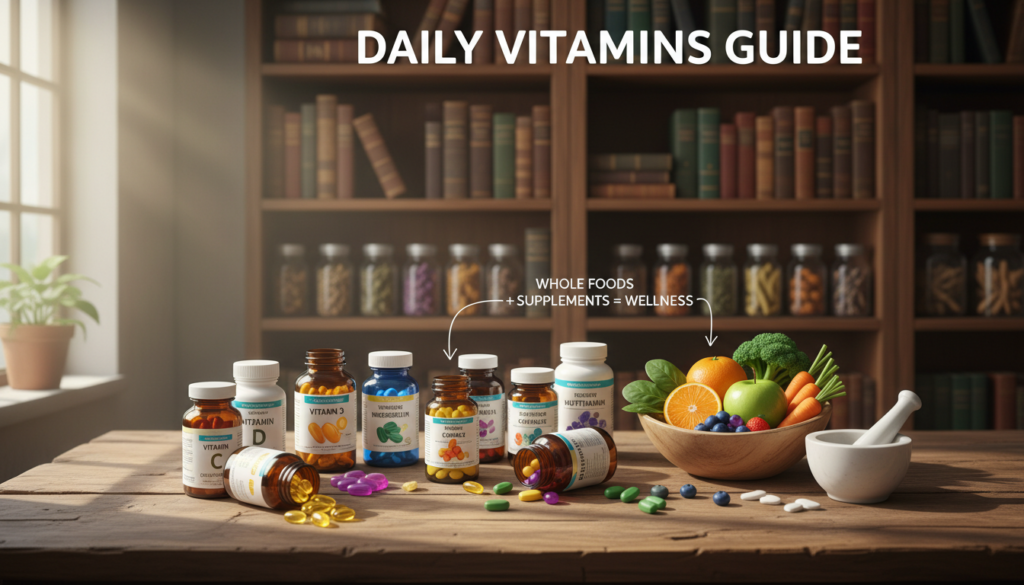
Many people look for a simple pill to perfect their health. The question of which nutrients to consume each day is common. Yet, solid science often tells a different story.
Americans spend around $60 billion every year on nutritional pills and powders. This is a massive industry. However, a large number of these products lack strong proof that they work for the average healthy person.
This guide cuts through the noise. It is based on evidence, not trends. Your first and best source of nutrition should always be a balanced plate of whole foods.
◈ Quick Answer: What Vitamins Should You Take Daily?
For most healthy adults, only a few vitamins are worth supplementing: Vitamin D (if sun exposure is limited), Vitamin B12 (if over 50 or vegan), and possibly Calcium. A balanced diet of whole foods covers the rest. Always confirm specific needs with a doctor through a blood test before starting any supplement.
We will explore how to get what your body needs from meals. You can then decide if adding anything extra is right for you. Making an informed choice saves money and supports your well-being.
Key Takeaways
- A varied, balanced diet usually provides all essential nutrients for healthy individuals.
- The U.S. supplement market is worth billions, but not every product is backed by solid science.
- Most people with good health do not require extra pills for longevity or disease prevention.
- Knowing how nutrients function in your body leads to smarter, more confident decisions.
- Focus on getting vitamins and minerals from food first before considering any supplement.
- Always talk to a doctor or dietitian before starting a new supplement routine.
- Be skeptical of marketing claims and seek out information from reliable, evidence-based sources.
Introduction: Unlocking Your Daily Vitamin Potential
Optimal well-being relies on a steady supply of specific organic compounds that your body cannot produce on its own. These essential nutrients act as catalysts for thousands of processes.
They keep your systems running smoothly from the inside out.
The Role of Vitamins in Daily Health
Thirteen essential vitamins form the core group. This includes A, C, D, E, K, and the B-complex family like thiamine and niacin.
Together with minerals, they perform critical jobs. They help you resist infections and keep your nerves healthy. They also convert your meals into usable energy.
For most people, following simple dietary guidelines helps them get enough of these nutrients.

Why Science-Backed Guidance Matters
Understanding how these compounds interact is key. Relying on whole food sources provides a complex array of nutrients that work in synergy.
This natural teamwork is often superior to taking isolated pills. Evidence-based advice helps you avoid unnecessary supplements. It ensures your choices support your health confidently.
| Feature | Whole Food Sources | Isolated Supplements |
|---|---|---|
| Nutrient Form | Complex, synergistic blend | Single or few compounds |
| Additional Benefits | Fiber, antioxidants, phytonutrients | Targeted dose of specific nutrient |
| Body Absorption | Often enhanced by food matrix | Can vary based on formula and individual |
| Primary Goal | Comprehensive nourishment | Addressing a specific deficiency |
Making informed decisions saves money and supports long-term wellness. Start by focusing on a colorful, varied plate.
Understanding the Science Behind Daily Vitamins
Trustworthy information about nutritional products comes from rigorous research and expert consensus. Relying on solid evidence helps you make choices that truly support your health.

Peer-Reviewed Studies and Expert Insights
Erin “Wren” Cahoon, a dietitian at UCHealth, emphasizes a food-first approach. She notes that a balanced plate with fruits, vegetables, and lean proteins often eliminates the need for extra pills. This foundation provides essential vitamin and mineral intake.
The Office of Dietary Supplements at the National Institutes of Health is a key resource. People can use it to verify product claims with accurate, up-to-date data. It helps check the science behind any vitamin or supplement.[1]
Many popular supplements lack rigorous proof of benefit for the average person.[10] Peer-reviewed science is essential to separate fact from fiction. It ensures your nutrition strategy is effective.
| Source Type | Key Strength | Potential Limitation |
|---|---|---|
| Peer-Reviewed Journals | Rigorous, unbiased evidence | Can be complex for the general public |
| Expert Dietitians | Personalized, practical advice | Requires a consultation |
| Office of Dietary Supplements | Authoritative, consumer-friendly data | Does not endorse specific brands |
Prioritizing whole foods over pills is a smart strategy. Only consider supplements if a healthcare professional identifies a specific deficiency. For instance, the evidence for vitamin D is clear for those with limited sun exposure.[13]
Understanding this science protects your wallet and your well-being. It guides you toward choices backed by real results.
What Vitamins Should I Take Daily
Major health organizations provide clear guidance that often contradicts popular supplement trends. Many wonder which pills are essential for their routine.
The answer is highly individual. For most healthy people, the best approach is surprisingly simple.
Essential Daily Supplements to Consider
Authoritative groups like the U.S. Preventive Services Task Force offer specific advice. They do not recommend multivitamins for preventing heart disease or cancer in the general population.[3]
For the broader public, no strong evidence shows these pills improve longevity.[5] Your body processes nutrients best from whole food sources.

There is no proof that multivitamins boost overall health if you are not deficient. Before buying, ensure any product contains the specific vitamin or mineral you lack.
It should not add unnecessary or harmful ingredients. We help you get nutrients from a variety of food sources first. This ensures you are not paying for supplements your system does not require.
| Your Situation | Recommended Action | Key Reason |
|---|---|---|
| General health maintenance | Prioritize a balanced diet rich in fruits, vegetables, and lean proteins | Whole foods provide a complex mix of vitamins and minerals that work together |
| Specific, diagnosed shortage (e.g., vitamin D) | Use a targeted supplement as directed by a healthcare professional | Corrects a measurable deficiency that diet alone may not fix |
| Considering a multivitamin for “insurance” | Typically not advised for healthy individuals without a known need | Lacks evidence of benefit and may contain unnecessary doses |
Always consult with a doctor or dietitian. They can determine if your unique body needs extra support beyond your meals. A personalized plan based on evidence is the safest path forward.
Exploring Dietary Supplements and Their Benefits
Unlike prescription drugs, dietary supplements operate under different regulatory standards. The U.S. Food and Drug Administration does not approve these products before they hit store shelves.[7] This means their powers can be overstated compared to regulated drugs.

Third-Party Testing and FDA Guidelines
Since the FDA does not regulate these items with the same rigor, consumers must be proactive. Look for seals from independent labs like NSF or USP. These third-party tests verify the purity and dosage accuracy of your dietary supplements.
Choosing a high-quality product requires checking the label carefully. This ensures you get exactly what you pay for and avoid harmful contaminants.
Supplements Versus Whole Foods
Dietary supplements can be useful tools, but they should never replace a varied diet. Whole foods like fruits and vegetables provide a complex mix of nutrients that work together synergistically.[11]
Think of any supplement as a potential complement, not a substitute. Prioritize getting your essential vitamins from meals first. Then, consider extra support only if a healthcare professional identifies a specific need.
Essential Vitamins for Men and Women
Life stage and gender play key roles in determining which nutrients your body requires most. Your needs for specific vitamins and minerals evolve over time.
Focusing on a few key players can make a big difference for long-term wellness.
Vitamin B12, Calcium, and Vitamin D Overview
Vitamin B12 is critical for red blood cell formation and nerve function. The body absorbs this nutrient less efficiently as we get older.[2] [12]
Adults aged 51 and older need 2.4 mcg daily. Many men and women over age 50 may need a supplement to meet this target.
Calcium is vital for maintaining strong bones. Adults aged 19 to 50 require 1,000 mg each day.[4]
Women over 50 and all adults over 70 need 1,200 mg daily to counteract age-related bone loss.
Vitamin D works with calcium to support bone density and immune function. Requirements increase to 20 mcg (800 IU) for those over age 70.

| Nutrient | Key Benefit | Adults 19–50 | Adults 51+ |
|---|---|---|---|
| Vitamin B12 | Red blood cell formation, nerve health | 2.4 mcg | 2.4 mcg (absorption may require supplement) |
| Calcium | Builds and maintains bone strength | 1,000 mg | 1,200 mg (women 50+, all 70+) |
| Vitamin D | Promotes calcium absorption, immune support | 15 mcg (600 IU) | 20 mcg (800 IU) (age 70+) |
Tailoring Vitamins for Individual Age Needs
Tailoring your intake of vitamins and minerals based on your specific age and gender is smart. A calcium and vitamin D combination is often suggested for older adults.
This helps maintain bone density and reduce fracture risk. Getting the right balance supports your health journey at every age.
Integrating Vitamins and Nutrient-Rich Foods in Your Diet
Building a nutritious diet is about more than just avoiding junk food. It’s about actively choosing foods that deliver essential nutrients every day.
Your plate should become a colorful mosaic of nourishment. This approach ensures you get enough vitamins and minerals naturally.
Maximizing the Benefits of Fruits, Vegetables, and Dairy
Fill your plate with a wide variety of fruits, vegetables, and whole grains. Add dairy products like milk or yogurt for a complete nutritional profile.
Green leafy vegetables such as spinach and kale are powerhouses. They provide a rich source of vitamins and minerals that support your health each day.
Including fortified foods can help fill any gaps. Make sure to read labels to identify these enhanced options.
For those over age 51, managing sodium is also key. Limiting intake to 2,300 mg per day helps maintain healthy blood pressure.
| Food Group | Primary Nutrients | Sample Serving & Benefit |
|---|---|---|
| Dairy (e.g., milk, yogurt) | Calcium, Vitamin D, Protein | 1 cup of milk provides 300–450 mg calcium for bone strength. |
| Green Leafy Vegetables | Vitamin K, Folate, Iron | Spinach offers vitamins and minerals that aid daily cell function. |
| Fortified Foods | Often Vitamin D, B12, Iron | Cereals or plant milks can help you get enough specific nutrients. |
The synergy of nutrients in whole foods is unmatched by any single pill.
Remember, consistency is key. Making these choices part of your routine builds lasting wellness.
Personalized Supplement Strategies for a Healthy Life
Your nutritional needs are as individual as your fingerprint, shaped by age, gender, and daily habits. A generic approach often fails to address what your body truly requires for optimal function.
Assessing Your Unique Nutritional Needs
Start by evaluating your life stage and lifestyle. Men and women have different requirements for nutrients like iron and protein.
The Office of Dietary Supplements notes that while pills can help, they should not replace the nutrients found in a balanced diet. Your unique nutrition plan must consider these factors.
Lifestyle Considerations and Age-Specific Guidance
As we age, our body undergoes muscle decline. Older men and women need adequate protein to support their health.
A 150-pound person requires about 50 grams of protein daily. Iron is crucial for maintaining healthy blood levels in women of childbearing age.[8]
Supplements for iron are generally only necessary for specific groups, like pregnant women. Always take them under medical supervision.
- Heart health: High blood pressure is a significant risk. Manage your intake of sodium and key minerals.
- Magnesium: Many people, especially men over 70, do not get enough.[9] Find it in whole grains and nuts.
- Overall strategy: Let your diet be the foundation. Use targeted supplements only when a specific need is identified.
This personalized path supports your long-term wellness and reduces unnecessary risk.
Conclusion
Your journey to better health doesn’t require a cabinet full of pills; it starts on your plate. A colorful variety of whole foods provides the complex nutrition your body needs each day. For most people, this is the most effective path to getting enough essential vitamins.
Specific situations, like certain life stages or medical conditions, may call for targeted support. Always discuss any new supplement plan with a doctor or dietitian first. They can ensure it’s safe and right for you.
Long-term wellness thrives on consistent, healthy eating habits. By understanding your unique needs, you make confident, informed choices. You support your health powerfully, without relying on unnecessary products.
📚 Related Reading
Frequently Asked Questions
What are the most important daily vitamins for most people? ▼
For general health, focusing on a few key nutrients is wise. Vitamin D is crucial for strong bones, immune function, and overall health, and many people don’t get enough from sun and food. Vitamin B12 supports nerve and blood cell health, especially important for older adults and those on plant-based diets. Minerals like calcium are foundational for bone strength. A high-quality multivitamin can help fill common gaps, but a diet rich in fruits, vegetables, and whole grains is your best foundation.
Should I rely on dietary supplements or food for my nutrients? ▼
Whole foods should always be your primary source. A colorful plate full of green leafy vegetables, fresh fruits, lean proteins, and dairy or fortified alternatives provides a complex matrix of nutrients that work together. Dietary supplements are best used to complement your diet, not replace it. They are helpful for specific needs, like vitamin B12 for vegans or calcium and vitamin D for postmenopausal women. Look for products verified by third-party testing for quality assurance.
How do my vitamin needs change as I get older? ▼
Nutritional requirements evolve with age. After 50, the body’s ability to absorb vitamin B12 from food often decreases, making a supplement a common recommendation. Bone health becomes a greater priority, increasing the need for adequate calcium and vitamin D to maintain strong bones and reduce fracture risk. Appetite and metabolism can also change, making a targeted supplement strategy more valuable to ensure you get enough essential nutrients.
I eat a balanced diet. Do I still need to take anything? ▼
If you consistently eat a wide variety of nutrient-dense foods, you may meet most of your needs. However, some nutrients are harder to obtain. Vitamin B12 is naturally found only in animal products, so those avoiding them might need a supplement. Also, few foods contain sufficient vitamin D. A blood test from your doctor can identify any specific deficiencies, providing a science-backed guide for what you truly need to take.
What should I look for when choosing a supplement? ▼
Safety and quality are paramount. Since the FDA does not approve supplements before sale, choosing brands that undergo rigorous third-party testing is key. Look for seals from organizations like USP or NSF. Check the label for the active ingredient amount and avoid mega-doses unless prescribed. Select a form you’ll take consistently — whether a capsule, gummy, or liquid.
Can taking vitamins prevent heart disease or other chronic conditions? ▼
While proper nutrition is vital for long-term health, popping pills isn’t a magic shield. Research from the Office of Dietary Supplements shows that for the general public, antioxidant supplements like vitamin E dosage and deficiency signs reduced heart disease risk. The most powerful approach combines a diet rich in vegetables, fruits, and whole grains with regular exercise. Think of dietary supplements as part of a larger, healthy lifestyle strategy, not a standalone solution.
Sources
- Vitamin D — Health Professional Fact Sheet. National Institutes of Health, Office of Dietary Supplements.
- Vitamin B12 — Health Professional Fact Sheet. National Institutes of Health, Office of Dietary Supplements.
- Vitamin Supplementation to Prevent Cancer and CVD: Preventive Medication. U.S. Preventive Services Task Force.
- Calcium — Health Professional Fact Sheet. National Institutes of Health, Office of Dietary Supplements.
- Multivitamin/Mineral Supplements — Health Professional Fact Sheet. National Institutes of Health, Office of Dietary Supplements.
- Vitamins. The Nutrition Source — Harvard T.H. Chan School of Public Health.
- Dietary Supplements. U.S. Food and Drug Administration.
- Iron — Health Professional Fact Sheet. National Institutes of Health, Office of Dietary Supplements.
- Magnesium — Health Professional Fact Sheet. National Institutes of Health, Office of Dietary Supplements.
- Fortmann SP, et al. Vitamin and mineral supplements in the primary prevention of cardiovascular disease and cancer. Ann Intern Med (2013). PubMed.
- Drewnowski A, Fulgoni V. Nutrient profiling of foods: creating a nutrient-rich food index. Nutr Rev (2008). PubMed.
- Allen LH. Vitamin B-12. Adv Nutr (2012). Age-related decline in B12 absorption. PubMed.
- Easy Ways to Boost Vitamin Intake for Better Health. Remedy’s Nutrition.